Matewan
It takes more than guns to kill a man.
Synopsis
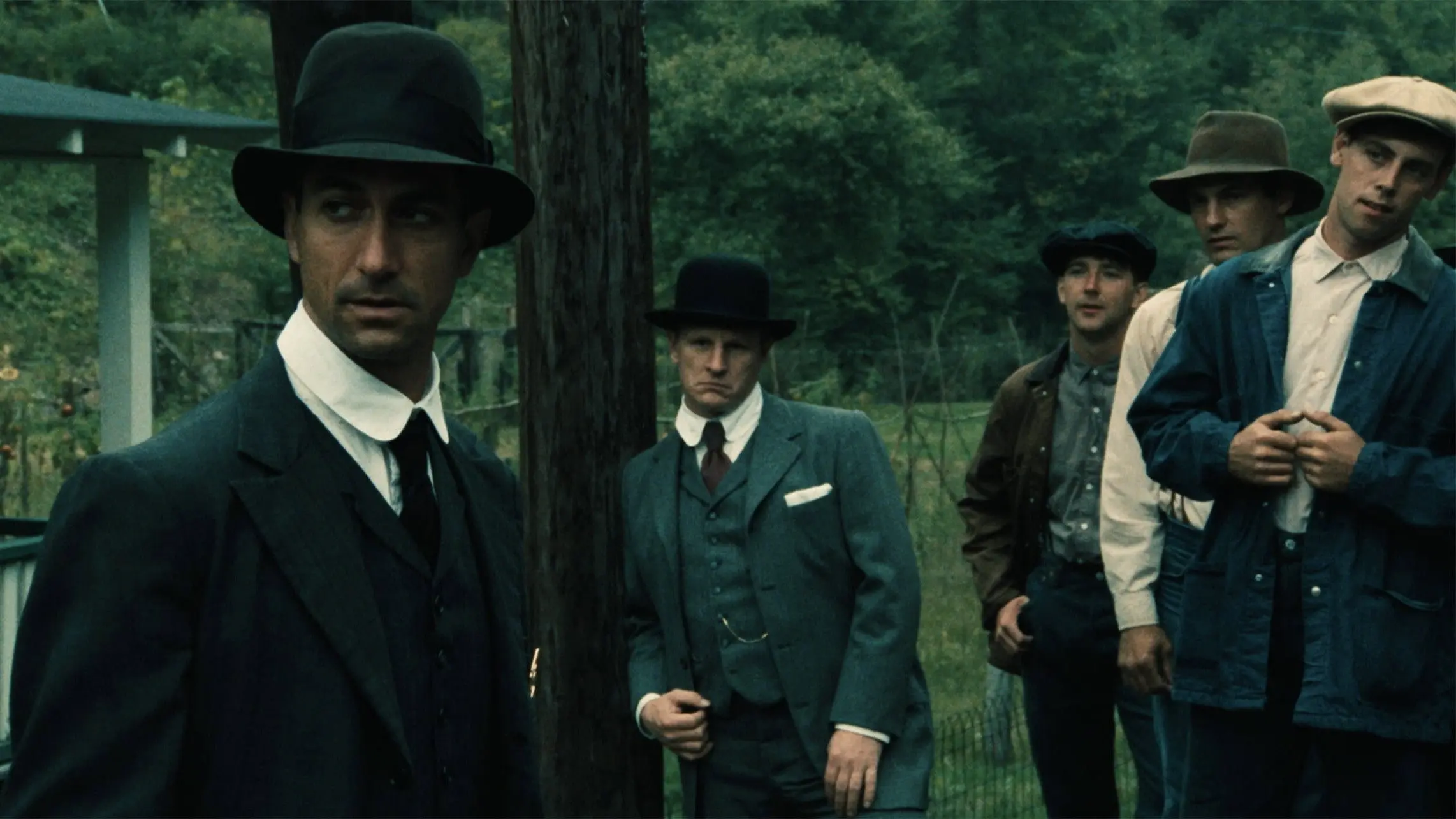
Filmed in the coal country of West Virginia, "Matewan" celebrates labor organizing in the context of a 1920s work stoppage. Union organizer, Joe Kenehan, a scab named "Few Clothes" Johnson and a sympathetic mayor and police chief heroically fight the power represented by a coal company and Matewan's vested interests so that justice and workers' rights need not take a back seat to squalid working conditions, exploitation and the bottom line.
Main Cast

Chris Cooper
Joe Kenehan

James Earl Jones
'Few Clothes' Johnson

Mary McDonnell
Elma Radnor

Will Oldham
Danny Radnor

David Strathairn
Police Chief Sid Hatfield

Ken Jenkins
Sephus Purcell

Kevin Tighe
Bill Hickey

Gordon Clapp
Tom Griggs

Bob Gunton
C.E. Lively

Jace Alexander
Hilllard Elkins
Trailer
User Reviews
CinemaSerf
With the dust barely settled after the Great War and the United States in the grip of an economic and social depression, a group of Virginian miners have had enough of being paid a pittance and being subjected to third-rate safety practices. Moreover, what they are paid is usually swallowed up in company stores or homes and so most of them find themselves and their families caught up in a poverty trap from which they consider a Trades Union may be their only escape. The owners, though, are wise to this strategy and so hire a firm of ruthless private detectives to ensure compliance with their policies. Perhaps untypically for the times, though, the nearby townsfolk all rally around the miners - especially when the company attempts to evict a few of their ertswhile workforce who are trying to rebel. That includes the mayor and the sheriff who are both prepared to stand up to "Hickey" (Kevin Tighe) and his heavily armed and motorised henchmen. The problem is for their enigmatic and openly pacifist leader, "Kenehan" (Chris Cooper) is that striking comes with considerable risks and given most are malnourished and poverty-stricken to start with, any loss of income is going to cut deep. On that front, he hopes to find an ally in the form of the politically and physically robust "Few Clothes" (James Earl Jones) - a man of few words but who epitomises a class struggle against exploitative absentee employers and landlords. It's narrated, of sorts, by a character who was but a youngster at the time of all of those shenanigans and that serves to knit things together quite successfully as metaphors fly fast and loose trying to reconcile the religiosity of those folks with that not always apparent in socialist teachings. It's speculative based loosely on real events, but there's nothing far-fetched about the personifications here and with JEJ delivering strongly and Cooper having something almost celestial to his persona, this proves to be quite a poignant look at just why unions ever evolved in the first place in the USA and at just how risky that process was in the face of powerful vested interests.